Más vendidaBPC-157 Guide
$14BPC-157: mechanism, reported effects, commonly cited dosage ranges, reconstitution math and named stacks — gastrointestinal and tissue-repair research.
Biblioteca Educativa
Una biblioteca creciente de 55 guías educativas de péptidos y tablas de referencia de dosificación, con recorridos pensados para principiantes, notas de interpretación en contexto de investigación y herramientas prácticas de aprendizaje.

Acceso a una Sola Guía
$14
Cualquier guía disponible
Acceso Total de por Vida
$99
Todas las guías — biblioteca actual + futura
Comience con las guías educativas más populares de la biblioteca y luego explore el resto del catálogo a continuación.
Más vendidaBPC-157: mechanism, reported effects, commonly cited dosage ranges, reconstitution math and named stacks — gastrointestinal and tissue-repair research.
Más vendidaFree GHK-Cu guide for skin, tissue, and cosmetic research: how it works, what studies report, reported dosage ranges, half-life, side effects and reconstitution math.
Más vendidaTB-500 explained — mobility and soft-tissue research. Evidence status, reported dosage ranges, reconstitution math, storage and named stacks.
Más vendidaCJC-1295: mechanism, reported effects, commonly cited dosage ranges, reconstitution math and named stacks — growth-hormone-axis research.
Explore la biblioteca completa de guías de péptidos. Todas las guías siguen el mismo formato educativo y se pueden comprar individualmente.
Free Ipamorelin guide: how it works, what studies report, reported dosage ranges, half-life, side effects and reconstitution math.

Semaglutide explained — metabolic and GLP-1 research. Evidence status, reported dosage ranges, reconstitution math, storage and named stacks.

Tirzepatide: mechanism, reported effects, commonly cited dosage ranges, reconstitution math and named stacks — metabolic and incretin research.

Free Retatrutide guide: how it works, what studies report, reported dosage ranges, half-life, side effects and reconstitution math.

Tesamorelin explained — body-composition and endocrine research. Evidence status, reported dosage ranges, reconstitution math, storage and named stacks.

Sermorelin: mechanism, reported effects, commonly cited dosage ranges, reconstitution math and named stacks — growth-hormone-axis research.

Free Thymosin Alpha-1 guide for immune research: how it works, what studies report, reported dosage ranges, half-life, side effects and reconstitution math.

PT-141 explained — melanocortin research. Evidence status, reported dosage ranges, reconstitution math, storage and named stacks.

Oxytocin: mechanism, reported effects, commonly cited dosage ranges, reconstitution math and named stacks — social-bonding and reproductive research.
Free Epithalon guide for cellular-aging research: how it works, what studies report, reported dosage ranges, half-life, side effects and reconstitution math.

KPV explained — skin, gut, and inflammatory research. Evidence status, reported dosage ranges, reconstitution math, storage and named stacks.

Selank: mechanism, reported effects, commonly cited dosage ranges, reconstitution math and named stacks — neurocognitive research.

Free Semax guide for neurocognitive research: how it works, what studies report, reported dosage ranges, half-life, side effects and reconstitution math.

DSIP explained — sleep and neuroendocrine research. Evidence status, reported dosage ranges, reconstitution math, storage and named stacks.

Kisspeptin-10: mechanism, reported effects, commonly cited dosage ranges, reconstitution math and named stacks — reproductive-axis research.

Free ARA-290 guide: how it works, what studies report, reported dosage ranges, half-life, side effects and reconstitution math.

5-Amino-1MQ explained — metabolic research. Evidence status, reported dosage ranges, reconstitution math, storage and named stacks.

MOTS-c: mechanism, reported effects, commonly cited dosage ranges, reconstitution math and named stacks — mitochondrial and metabolic research.
Free SS-31 guide: how it works, what studies report, reported dosage ranges, half-life, side effects and reconstitution math.

IGF-1 LR3 explained — growth-factor and anabolic-signaling research. Evidence status, reported dosage ranges, reconstitution math, storage and named stacks.

Glutathione: mechanism, reported effects, commonly cited dosage ranges, reconstitution math and named stacks — oxidative-stress and detoxification research.
Free SLU-PP-332 guide: how it works, what studies report, reported dosage ranges, half-life, side effects and reconstitution math.

GHRP-2 explained — growth-hormone-secretagogue and ghrelin-receptor research. Evidence status, reported dosage ranges, reconstitution math, storage and named stacks.

GHRP-6: mechanism, reported effects, commonly cited dosage ranges, reconstitution math and named stacks — growth-hormone-secretagogue and appetite-signaling research.
Free Melanotan II guide: how it works, what studies report, reported dosage ranges, half-life, side effects and reconstitution math.

Mod GRF 1-29 / CJC-1295 no DAC: the only human CJC-1295 study tested the DAC version at 60-90 mcg/kg, the unmeasured half-life, unit math, and what a purity report can establish.
NA-Semax Amidate: mechanism, reported effects, commonly cited dosage ranges, reconstitution math and named stacks — neuroprotective and cognitive-signaling research.
N-Acetyl Selank Amidate: the +41 Da mass difference a certificate of analysis must show, why purity cannot establish identity, the salt-form correction to every concentration, and the two figures this page retracted.
Gonadorelin explained — hypothalamic-pituitary-gonadal (HPG) axis research. Evidence status, reported dosage ranges, reconstitution math, storage and named stacks.

Cagrilintide: the dosing chart in insulin-syringe units, the sourced 159-195 hour half-life, and what the 2026 REIMAGINE and REDEFINE phase 3 trials measured — including the 0.16-point HbA1c result.
Free NAD+ guide: how it works, what studies report, reported dosage ranges, half-life, side effects and reconstitution math.

LL-37 explained — antimicrobial, wound-repair, and immune-modulation research. Evidence status, reported dosage ranges, reconstitution math, storage and named stacks.

Cartalax (AED, Ala-Glu-Asp): the sequence it is actually indexed under, what its six published cell-culture studies tested, reported dosage ranges, reconstitution math and named stacks.

Free Thymalin guide for thymic and immune-modulation research: how it works, what studies report, reported dosage ranges, half-life, side effects and reconstitution math.

Thymulin (FTS-Zn): the zinc-dependent thymic nonapeptide — how it differs from Thymalin, what the two double-blind human trials actually found, published trial doses, reconstitution math and storage.

MGF, the IGF-1Ec E-peptide: two pharmaceutical companies could not reproduce its claimed effect, no half-life has ever been measured, and the active research on it is oncology. PEG-MGF has its own guide.
Follistatin 344: mechanism, reported effects, commonly cited dosage ranges, reconstitution math and named stacks — myostatin-inhibition and muscle-mass research.
Free Hexarelin guide: how it works, what studies report, reported dosage ranges, half-life, side effects and reconstitution math.

VIP explained — immune-modulation and inflammatory research. Evidence status, reported dosage ranges, reconstitution math, storage and named stacks.

PE-22-28: mechanism, reported effects, commonly cited dosage ranges, reconstitution math and named stacks — TREK-1 channel and mood/neurogenesis research.
Free AHK-Cu guide: how it works, what studies report, reported dosage ranges, half-life, side effects and reconstitution math.

Melanotan I explained — melanocortin and skin-pigmentation research. Evidence status, reported dosage ranges, reconstitution math, storage and named stacks.

AOD-9604: the confirmatory Phase 2b that missed its endpoint, why every human trial was oral or IV, reported dosage, reconstitution math and stacks.

HGH Fragment 176-191: what its own cited sources actually show, how it differs from AOD-9604 and the 177-191 sequence, dosage and reconstitution math.

Pinealon (EDR): the Khavinson short-peptide literature and who produced it, the rodent-to-human dose gap, reported dosage and reconstitution math.

Dihexa: the retracted literature behind the nootropic claims, the unresolved tumour-growth concern, why it needs DMSO rather than bacteriostatic water.
PEG-MGF: what PEGylation does and does not change, the unmeasured half-life claim, the vendor non-standardisation problem, and reconstitution math.

Cerebrolysin: a porcine brain hydrolysate, not a peptide — the trial infusion regimens, the 1,070-patient CASTA null result, Cochrane's dose-linked adverse-event finding, and why no reconstitution math applies.

Mazdutide (IBI362 / LY3305677): the glucagon/GLP-1 dual agonist approved in China in 2025 — the 4 mg, 6 mg and 9 mg phase 3 doses, what 9 mg cost in adverse events, and the reconstitution math.

Survodutide (BI 456906): the investigational glucagon/GLP-1 dual agonist — what SYNCHRONIZE-1 reported at 3.6 mg and 6.0 mg weekly, the months-long titration, and the reconstitution math.

P11-4 (Curodont, oligopeptide-104): a self-assembling dental enamel biomaterial — applied to a tooth surface rather than injected, and not systemic.
Dos guías independientes cubren el material que no pertenece a ningún compuesto en particular — cómo se construyen las combinaciones y cómo se interpretan los análisis de sangre que las miden. Ambas se incluyen con el Acceso Total de por Vida.
Guía independienteThe cross-compound stacking reference: the named blends, which pairings are redundant rather than additive, where interaction risk is documented versus merely unstudied, and the blend arithmetic.
Guía independienteWhich blood markers matter on peptides, how each one is read against your own baseline rather than a population range, and the marker map for every compound in the library.
Elija el acceso a una sola guía para cualquier guía disponible actualmente, o el acceso de por vida a toda la biblioteca, que incluye las guías actuales y las futuras.
Acceso Estándar a una Sola Guía
$14
Acceso a un tema de guía a la vez. Abajo se muestra el agregado rápido para las guías disponibles.
Acceso Total de por Vida
$99
Acceso a toda la biblioteca: las 55 guías — lanzamientos actuales y futuros — más recursos descargables.
La biblioteca utiliza un formato repetible de doce secciones para cada guía: qué es el compuesto y cómo funciona, los efectos y efectos secundarios reportados en la investigación, la evidencia y el estatus regulatorio, los rangos de dosificación comúnmente citados, los cálculos de reconstitución con una calculadora integrada, la semivida, los stacks con nombre, el almacenamiento y las referencias que respaldan todo ello.
Secciones 1–4
Qué es y cómo funciona
El compuesto, su mecanismo, los efectos reportados en la investigación, y su evidencia y estatus regulatorio.
Secciones 5–8
Las cifras prácticas
Rangos de dosificación comúnmente citados en la investigación, cálculos de reconstitución con una calculadora integrada, aspectos básicos de administración y semivida — ejemplos de lo que se reporta, no instrucciones.
Secciones 9–12
Precauciones, stacks y fuentes
Efectos secundarios reportados, stacks con nombre, almacenamiento y las referencias de las fuentes — la misma estructura en las 55 guías.
Una tabla de referencia gratuita que cubre todos los compuestos de la biblioteca en una sola tabla — sin cuenta y sin descargas. Cada fila muestra el rango comúnmente reportado para ese compuesto y su semivida plasmática, con un enlace a la guía completa y a una calculadora de reconstitución gratuita. Las filas se generan a partir del propio contenido de las guías, en lugar de mantenerse como una tabla aparte, por lo que la tabla no puede contradecir las páginas que resume; cuando una celda muestra un guion, la cifra está indicada en la página de la guía en una forma que esta tabla no puede condensar, y la guía es la referencia.
Dos cosas que conviene leer con atención. Estos son ejemplos de lo que se reporta en la investigación publicada y en fuentes de la comunidad — no son recomendaciones, no son instrucciones de uso personal y no son una dosis para ninguna persona. Y cuando no existe ningún estudio farmacocinético publicado en humanos, la columna de semivida así lo indica en lugar de repetir una cifra que circula sin fuente; varias semividas de péptidos ampliamente citadas nunca se han medido en humanos.
| Compuesto | Rango comúnmente reportado (ejemplo, no una recomendación) | Semivida plasmática | Guía |
|---|---|---|---|
| 5-Amino-1MQ | Community sources describe oral doses of roughly 50–150 mg per day — anecdotal, not derived from any human study. Mouse efficacy work used 10 and 32 mg/kg/day subcutaneously. | Measured in mice in 2024, not in humans: terminal half-life 6.3 h after intravenous dosing, 12.8–13.3 h subcutaneous, 14.8 h oral. | 5-Amino-1MQ guía |
| AHK-Cu | Topical: 2-5% scalp serum; subcutaneous (community-reported): ~50-200 mcg daily | Not formally established in humans; small copper-peptide complexes are believed to clear rapidly | AHK-Cu guía |
| AOD-9604 | 250-500 mcg/day subcutaneously (~300 mcg the modal figure) — no published human trial or pharmacokinetic study supports this route or dose | — | AOD-9604 guía |
| ARA-290 | Phase 2 trials tested 1, 4 and 8 mg daily by subcutaneous injection; 4 mg met the primary endpoint | Very short - reported on the order of minutes | ARA-290 guía |
| BPC-157 | ~250–500 mcg per day (community-reported; some report split AM/PM dosing). | Reported under 30 minutes. | BPC-157 guía |
| Cagrilintide | 0.16, 0.30, 0.60, 1.2, 2.4 and 4.5 mg once weekly in phase 1b dose-ranging; 1.0 mg and 2.4 mg once weekly are the two doses carried into the 2026 phase 3 program. | 159-195 hours (about 6.6-8.1 days) across 0.16-4.5 mg, with median tmax 24-72 hours. | Cagrilintide guía |
| Cartalax | Roughly 1–2 mg/day subcutaneous or 10–20 mg/day oral in community write-ups. These figures trace to vendor and forum sources, not to any published study — no published work has administered… | Not established in any species. No pharmacokinetic study of AED has been published, so there is no measured half-life, clearance or bioavailability… | Cartalax guía |
| Cerebrolysin | The trial regimens, all intravenous: 30 mL/day in 100 mL saline for 10 days (stroke, the CASTA regimen); 50 mL/day for 10 days then two cycles of 10 mL/day (CAPTAIN, TBI); | Not established, and arguably not a well-formed question for a mixture. PubMed records pairing cerebrolysin with pharmacokinetics or half-life are… | Cerebrolysin guía |
| CJC-1295 | DAC form — 30, 60 and 90 mcg/kg as single subcutaneous injections across two trials (PMID 16352683, PMID 17018654) — roughly 2,100, 4,200 and 6,300 mcg for a 70 kg adult. | DAC form: 5.8-8.1 days (PMID 16352683). No-DAC form: no published human measurement — see below. | CJC-1295 guía |
| Dihexa | Community and grey-market reports cluster at 5-10 mg daily described as "low" and 10-20 mg daily described as "moderate", for 4-8 weeks. | — | Dihexa guía |
| DSIP | Community sources describe roughly 100-250 mcg subcutaneously before bed; the human trials instead used about 25 nmol/kg intravenously. | Reported at roughly 7-15 minutes in early intravenous human work — very short, and a poor match for a compound expected to act across a night. | DSIP guía |
| Epithalon | Community examples of roughly 5-10 mg per day for short courses (no established human dose) | Very short - minutes; no established human pharmacokinetic profile | Epithalon guía |
| Follistatin 344 | Community-reported figures cluster around 100 mcg per administration. There is no trial dose to report because no published trial has injected follistatin protein into a human — the figures… | No published pharmacokinetic study of injected, unmodified follistatin in humans could be located. | Follistatin 344 guía |
| GHK-Cu | Topical formulations commonly 0.05-2%; injectable research examples around 1-2 mg per administration (no established human dose) | Short - GHK is cleared rapidly from plasma; no well-established human half-life for the copper complex | GHK-Cu guía |
| GHRP-2 | 100-300 mcg per injection (community-reported examples) | Approximately 1-2 hours (GH pulse peaks 15-30 minutes post-dose) | GHRP-2 guía |
| GHRP-6 | 100-300 mcg per injection (community-reported saturation dose ~1 mcg/kg) | Reported ~15-20 minutes (short); some sources cite a terminal phase up to ~2.5 hours | GHRP-6 guía |
| Glutathione | Community injection reports describe ~200-600 mg per session, 1-3x weekly. The doses with data behind them are 1,400 mg IV three times weekly (Parkinson's trial, null result) and 250-500 mg… | Measured at 14.1 +/- 9.2 minutes in 10 healthy volunteers after a 2 g/m2 intravenous infusion (Eur J Clin Invest 1991) | Glutathione guía |
| Gonadorelin | ~50-200 mcg per injection in community and research reports (not a recommendation) | Very short: ~2-10 min distribution, ~10-40 min terminal | Gonadorelin guía |
| Hexarelin | 100-200 mcg per subcutaneous injection is the range described in community sources (not a recommendation, and not what the trials used) | Reported at roughly 55-80 minutes — a figure that circulates widely but is not stated in the abstracts of the human trials most often cited for it | Hexarelin guía |
| HGH Fragment 176-191 | 250-500 mcg per injection in community settings; 250 mcg is the near-universal reported starting point. | — | HGH Fragment 176-191 guía |
| IGF-1 LR3 | ~20-100 mcg per day in community write-ups. No validated human dose exists and no dose-finding study has ever been run | Not established in humans. The widely repeated "20-30 hours" is unsourced and points the wrong way - see the half-life section, where the FDA label… | IGF-1 LR3 guía |
| Ipamorelin | ~100–300 mcg per dose (community-reported). | Reported ~2 hours. | Ipamorelin guía |
| Kisspeptin-10 | Published human work used intravenous infusion, e.g. 1.5 mcg/kg/h in George et al. 2011; community-reported subcutaneous figures (~50-200 mcg) are anecdotal and have no trial behind them. | No established human figure. In vitro the peptide decomposes with a half-life of 1.7 min at 37 C (Liu 2013); | Kisspeptin-10 guía |
| KPV | Roughly 250-500 mcg per day subcutaneously, sometimes split into two administrations; oral protocols are discussed at milligram amounts. | No published human pharmacokinetic study reports one. The figures circulating on commercial pages are not traceable to a measurement. | KPV guía |
| LL-37 | ~100–500 mcg per administration in community reports (no established human protocol) | Short; estimated on the order of ~1 hour, highly dependent on proteolysis | LL-37 guía |
| Mazdutide | 4 mg and 6 mg once weekly in GLORY-1 and in both DREAMS phase 3 trials; 9 mg once weekly in GLORY-2; 3 mg, 4.5 mg and 6 mg in the phase 2 programme; a 32-person phase 1 escalated to 16 mg. | Not established in the indexed literature. A PubMed search pairing mazdutide — or either development code, which return the same record set — with… | Mazdutide guía |
| Melanotan I | One 16 mg implant, repeated every 60 days in the pivotal trials — a solid, white to off-white, bioresorbable sterile rod approximately 1.7 cm long and 1.45 mm in diameter, inserted… | No published figure for injected melanotan 1 — the compound was developed as a controlled-release implant, so the pharmacokinetics that were… | Melanotan I guía |
| Melanotan II | ~250–500 mcg per dose in community reports | Reported short, roughly 30 minutes to ~1 hour | Melanotan II guía |
| MGF | 200-400 mcg per injection in community reports, with a wider span of roughly 100-600 mcg. No trial of any kind establishes a dose for this peptide. | Never measured. No published pharmacokinetic study reports a half-life for the MGF E-peptide in any species. | MGF guía |
| Mod GRF 1-29 | ~100 mcg per injection is the figure the market repeats as a 'saturation dose'; reported protocols span roughly 100-300 mcg. No trial establishes this range for the no-DAC peptide. | No measured value has been published for this peptide. The ~30 minutes commonly quoted is an inference from DPP-IV resistance, not a measurement; | Mod GRF 1-29 guía |
| MOTS-c | Roughly 5-10 mg per administration in research-community discussion, with no published human dose behind it. | — | MOTS-c guía |
| NA-Selank Amidate | ~250–900 mcg per day in divided applications, intranasal, from community sources rather than from any trial. | Not established; the widely repeated "20–30 minutes" is leu-enkephalin's half-life, not Selank's, and is withdrawn here. | NA-Selank Amidate guía |
| NA-Semax Amidate | Roughly 300–900 mcg per day in vendor and community protocols, often split across one to three administrations. | Not established for the analog, and poorly established for Semax itself. The one indexed measurement — Semax incubated with rat brain plasma… | NA-Semax Amidate guía |
| NAD+ | 50-100 mg subcutaneous per injection (community-reported); higher amounts reported for IV in clinical settings. | Short; serum half-life reported under ~1 hour, with rapid intracellular uptake. | NAD+ guía |
| Oxytocin | Intranasal research most often uses 24 IU per administration; the largest trial used 48 IU daily. Research-vial reports describe roughly 100-200 mcg. No validated non-obstetric dose | About 1 to 6 minutes per the FDA-approved label, decreased further in late pregnancy and during lactation | Oxytocin guía |
| P11-4 | — | Not established, and not a meaningful parameter for this compound. There is no human pharmacokinetic data because it is never given systemically. | P11-4 guía |
| PE-22-28 | 50-200 mcg per administration is what circulates in community and vendor material. No human dose exists. | Not established for PE-22-28 in any species. The frequently quoted '23 hours' is NOT a half-life and is NOT PE-22-28 — it is a half-time of… | PE-22-28 guía |
| PEG-MGF | 200-400 mcg per administration in community and research-setting reports. No dose has ever been established in any species for the PEGylated form. | — | PEG-MGF guía |
| Pinealon | 1-2 mg once daily subcutaneously (a minority report 5-10 mg/day); oral capsules approximately 1-20 mg/day in the Khavinson consumer line. | — | Pinealon guía |
| PT-141 | 1.75 mg subcutaneously into the abdomen or thigh, as needed, at least 45 minutes before anticipated sexual activity. | Approximately 2.7 hours, with a reported range of 1.9 to 4.0 hours. Tmax is about 1 hour. These are measured label values, not estimates. | PT-141 guía |
| Retatrutide | Phase 2 escalated to 12 mg once weekly; the published phase 3 used fixed 4 mg, 9 mg and 12 mg arms (reported, not an established dose). | No numeric half-life appears in the published phase 1 abstract; it reports a PK profile 'supporting once-weekly dosing' and a weight effect… | Retatrutide guía |
| Selank | Research and community examples of roughly 250-500 mcg per administration (no established Western dose) | No primary pharmacokinetic study establishing a plasma half-life for Selank was located in any species; | Selank guía |
| Semaglutide | Label escalation 0.25 to 2.4 mg once weekly (Wegovy); maintenance 1.7 or 2.4 mg once weekly | Approximately 1 week (elimination half-life about 155 hours) | Semaglutide guía |
| Semax | Community figures cluster around 300-600 mcg per administration; the registered Russian product is a 0.1% or 1% intranasal drop, dosed in drops rather than by weight. | Minutes. The Pro-Gly-Pro tail slows degradation relative to the bare ACTH fragment but does not make it long-lived. | Semax guía |
| Sermorelin | 30 micrograms per kilogram per day, subcutaneously at bedtime, in growth-hormone-deficient children. | Very short and properly measured: an initial phase of about 1.9 +/- 0.2 minutes and an elimination phase of about 10.4 +/- 0.2 minutes for… | Sermorelin guía |
| SLU-PP-332 | No human dose is established. There is no human pharmacokinetic study, no dose-response data and no bioavailability figure for any route in humans. | Unknown in humans — no human pharmacokinetic study of SLU-PP-332 has been published, so any specific human figure is unsourced. | SLU-PP-332 guía |
| SS-31 | 40 mg subcutaneously once daily, at the same time each day, in patients weighing at least 30 kg; reduced in severe renal impairment. | The label does not state one. It gives Tmax, bioavailability, distribution, metabolism and complete urinary recovery by 48 hours, but no elimination… | SS-31 guía |
| Survodutide | The doses with phase 3 data behind them are 3.6 mg and 6.0 mg subcutaneously once weekly, each reached by titration from 0.3 mg. | Consistent with once-weekly dosing, but we could not source a specific published half-life figure from the trial reports checked. | Survodutide guía |
| TB-500 | Roughly 2-5 mg per administration during a reported loading phase, then a lower weekly figure. These are community-reported numbers with no human dose-finding study behind them - the trial… | No published human half-life exists for the fragment. Figures of roughly 2-3 hours circulating online belong to the parent protein, and the new… | TB-500 guía |
| Tesamorelin | Label 1.28–2 mg/day across Egrifta formulations; off-label reports ~1–2 mg/day (examples, not recommendations). | 8 min (Egrifta SV) / 11 min (Egrifta WR) per label; ~26–38 min reported for the original formulation. | Tesamorelin guía |
| Thymalin | 5-10 mg per day (community and Russian clinical protocols); reconstitution here is concentration math only, not a personal dose. | Not well characterized; individual peptide fractions are reported to clear rapidly (minutes to a few hours), while biological effects are reported to… | Thymalin guía |
| Thymosin Alpha-1 | 1.6 mg subcutaneously twice weekly. This is the figure used in registered trials, not a recommendation. | Approximately 2 hours, with peak serum concentration within 2 hours and levels back to baseline within 24 hours (Ancell et al., 2001). | Thymosin Alpha-1 guía |
| Thymulin | 1, 5 and 10 mg/day were compared in the RA trials, with 5 mg/day the most effective arm. These are published trial figures, not recommendations. | Not established — no published human pharmacokinetic study reports a half-life figure for thymulin. | Thymulin guía |
| Tirzepatide | Label starts at 2.5 mg once weekly; maintenance doses are 5, 10 or 15 mg once weekly | Approximately 5 days (about 117 hours) | Tirzepatide guía |
| VIP | Community intranasal protocols report 50 mcg per nostril up to 4x daily (~400 mcg/day); subcutaneous examples of 25-100 mcg once daily. | Consistently described as very short, which is why every trial infused it rather than injecting a bolus. | VIP guía |
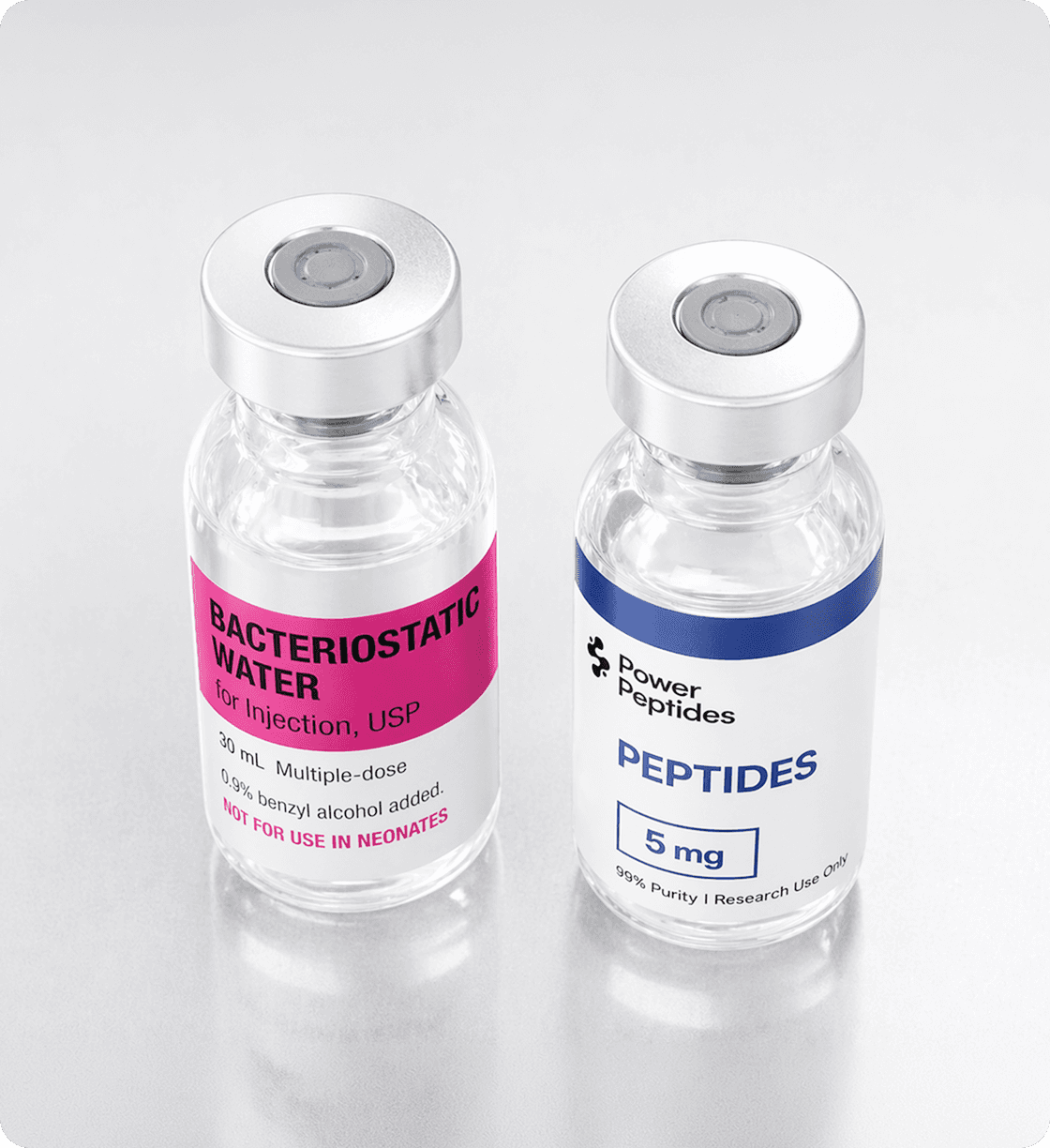
La mayoría de estos compuestos se suministran como polvo liofilizado, y reconstituirlos requiere agua bacteriostática y la aritmética de concentración que la acompaña — la concentración en mg/mL es el contenido en miligramos del vial dividido entre los mililitros añadidos. Unos pocos no se reconstituyen en absoluto y así lo indican en sus propias páginas. Use la calculadora de dosificación gratuita o compre agua bacteriostática de grado USP.
Cada guía sigue la misma estructura de doce secciones: qué es el compuesto, cómo funciona, los efectos reportados en la investigación, la evidencia y el estatus regulatorio, los rangos de dosificación comúnmente citados en los estudios y en la práctica, los cálculos de reconstitución con una calculadora integrada, los aspectos básicos de administración, la semivida, los efectos secundarios reportados, los stacks con nombre, el almacenamiento y las referencias de las fuentes. El acceso a una sola guía añade el Evidence File, el Sourcing File y la Benefit & Outcome Review de ese compuesto; el Acceso Total añade los de todos los compuestos, además de las hojas de protocolo imprimibles. Las guías son material educativo de referencia — las cifras de dosificación son ejemplos de lo que se reporta, no instrucciones de uso personal.
La Protocol Sheet y el Injection Log imprimibles — referencia de reconstitución, protocolo de ejemplo reportado, aspectos básicos de inyección, stacks comunes y almacenamiento — se incluyen con el Acceso Total de por Vida, que cubre todos los compuestos de la biblioteca más los lanzamientos futuros. El acceso a una sola guía es la profundidad escrita para un compuesto: su Evidence File, su Sourcing File y su Benefit & Outcome Review.
55 temas de guías de péptidos en la actualidad, que cubren compuestos como BPC-157, TB-500, GHK-Cu, CJC-1295, Semaglutide, Tirzepatide y Retatrutide. El Acceso Total de por Vida también incluye los futuros lanzamientos de guías a medida que la biblioteca crece.
El Acceso Estándar a una sola guía desbloquea los tres archivos de pago de un compuesto: el Evidence File, el Sourcing File y la Benefit & Outcome Review. El Acceso Total de por Vida los desbloquea para toda la biblioteca — guías actuales y futuras — además del paquete de referencia en PDF descargable y del paquete de hojas de trabajo imprimibles.
No. Las guías son únicamente material de referencia educativo en contexto de investigación. No proporcionan instrucciones de dosificación, administración ni protocolos de uso personal.
Sí — la tabla de referencia anterior es gratuita, no requiere cuenta y cubre los 55 compuestos de la biblioteca en una sola tabla, indicando el rango comúnmente reportado y la semivida plasmática de cada uno, con un enlace a la guía completa. Se genera a partir del mismo contenido de las guías en lugar de mantenerse por separado, por lo que no puede contradecir las páginas individuales; un guion significa que la cifra está indicada en la página de la guía en una forma que la tabla no puede condensar. Las cifras son ejemplos de lo que se reporta en la investigación y en fuentes de la comunidad, no instrucciones de uso personal.
La semivida es el tiempo que tarda la concentración de un compuesto en plasma en reducirse a la mitad, y es la cifra que más condiciona cómo se estudia un compuesto — es la razón por la que sermorelin, que se elimina en unos diez minutos, se ensayó como una inyección diaria a la hora de acostarse, mientras que un análogo de acción prolongada no. Se incluye en la tabla porque es la cifra más buscada y más frecuentemente mal citada de esta categoría. Cuando no existe ningún estudio farmacocinético en humanos, la tabla así lo indica en lugar de repetir un número que circula sin fuente.
La concentración en mg por mL es igual al contenido en miligramos del vial dividido entre los mililitros de agua bacteriostática añadidos; las unidades de la jeringa equivalen entonces a (cantidad objetivo ÷ concentración) × 100, porque una jeringa de insulina U-100 de 1 mL está graduada en 100 unidades a lo largo de un mililitro. Un vial de 10 mg mezclado con 2 mL da 5 mg/mL, por lo que una cantidad de 5 mg son 100 unidades — una jeringa completa. Medibact publica una página de calculadora independiente y gratuita para 51 de los 55 compuestos de la biblioteca; las excepciones son los que no se reconstituyen en absoluto. Esto es aritmética de concentración, no orientación de dosificación.
En ambas fuentes, y cada guía las distingue explícitamente en lugar de mezclarlas. Cuando existe una etiqueta aprobada por la FDA — como ocurre con SS-31 (Forzinity), PT-141 (Vyleesi) y tesamorelin (Egrifta) —, la dosis aprobada, la farmacocinética y la tabla de reacciones adversas se toman de la etiqueta y se citan como tales. Cuando existen datos de ensayos sin aprobación, la guía cita el ensayo, incluidos los negativos y los interrumpidos. Cuando solo existen informes de la comunidad, la guía lo dice con claridad y explica de dónde proceden las cifras. Varias guías indican que no existe una semivida publicada en humanos, en lugar de repetir un número sin fuente.
Solo con fines educativos: no constituye consejo médico. Esta página resume información procedente de la investigación publicada y del debate especializado, con fines educativos. No es consejo médico ni una recomendación de usar ninguna sustancia. Las cantidades, pautas o combinaciones mencionadas son ejemplos de lo que se ha comunicado, no instrucciones para usted. Muchos de los péptidos descritos aquí son sustancias de investigación no autorizadas para los usos comentados, y su situación regulatoria varía según el país. Los efectos, los riesgos y el marco legal varían, igual que las circunstancias individuales. Consulte a un profesional de la salud cualificado y habilitado para ejercer antes de tomar cualquier decisión. No utilice este contenido para diagnosticarse, tratarse o dosificarse por su cuenta.