

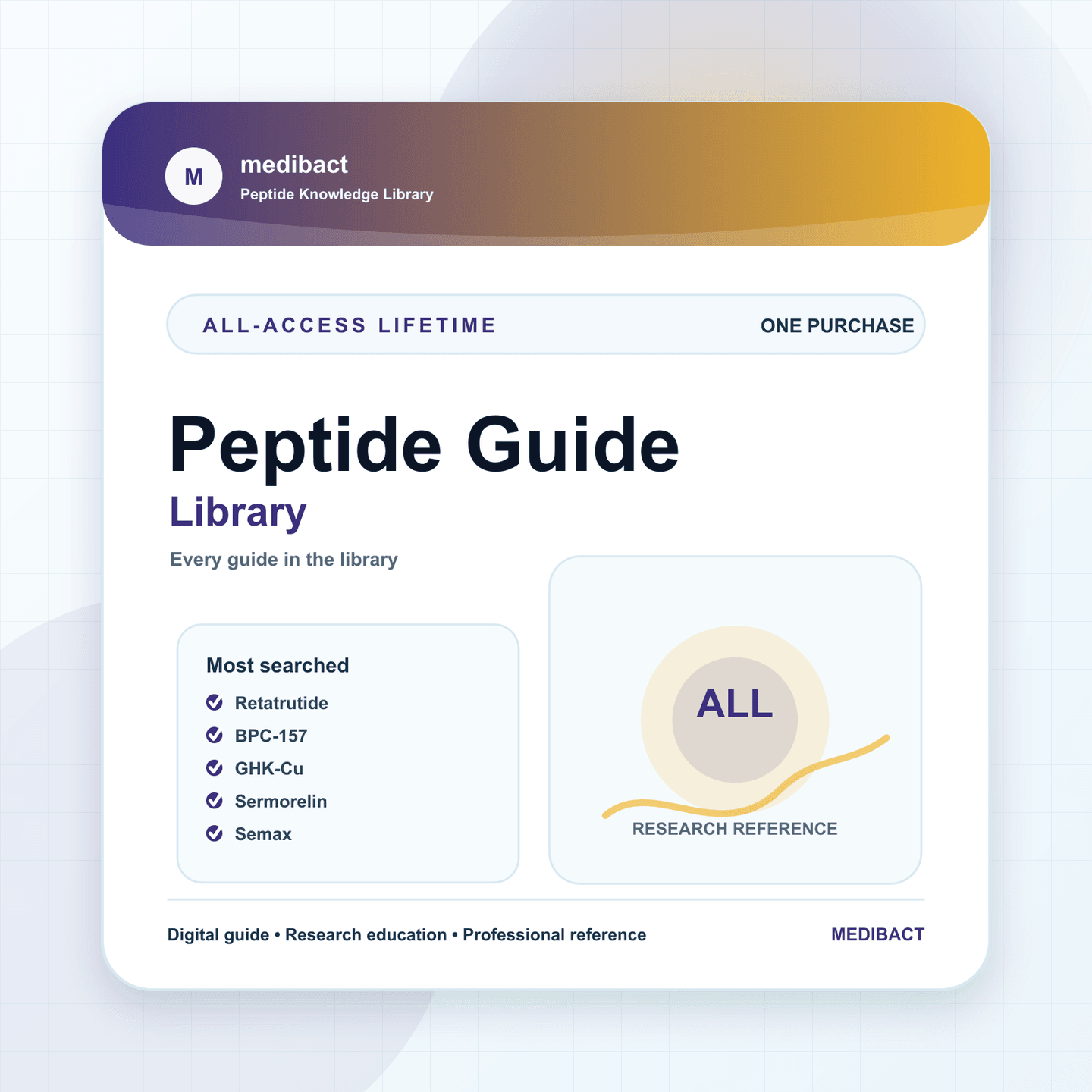
Peptide Guide Library — All-Access Lifetime
Productinformatie
$99.00
Productomschrijving
Directe digitale toegang. Toegevoegd aan uw Medibact-account zodra de betaling is bevestigd — er wordt niets verzonden en u hoeft nergens op te wachten.
Log in en open uw gidsenbibliotheek om elke gids online te lezen en de printbare referentiebladen te downloaden, op elk apparaat, zolang u het account hebt.
What lifetime all-access includes
One payment opens every guide in the Medibact Peptide Guide Library — 55 per-compound guides, the standalone Peptide Blood Marker Guide, and every guide released afterwards. Nothing is shipped; access is added to your Medibact account as soon as payment is confirmed.
Printables that are already filled in
The moment that actually needs a reference is the one at the bench, with a vial in hand — and that is the moment a screen is least useful. Every compound comes with a printable reference sheet: its key facts, storage guidance and a blank vial record. The written guides stay free and open to everyone, signed in or not. What all-access buys is the paid depth behind them and the pre-filled sheet you can take away from the screen.
Guides that publish the unflattering finding
Most peptide writing is downstream of the people selling the peptide, so the failed trial, the retraction and the wrong route of administration tend not to survive the trip. These guides are built from primary sources — FDA labels, trial registries and the papers themselves — and they lead with the deflationary fact instead of burying it. Four examples, each sourced in full on its own page:
- AOD-9604
The confirmatory 24-week Phase 2b (METAOD006) missed its primary endpoint — no significant separation from placebo at 12 or 24 weeks — and Metabolic Pharmaceuticals terminated obesity development in February 2007. No Phase 3 was ever run. The efficacy result was never published in a journal, which is why the earlier positive signal is still the one quoted.
- SS-31 / elamipretide
Approved in 2025 as Forzinity, so it has something almost nothing else here has: a real FDA label. That label states plainly that elamipretide was not superior to placebo on either primary endpoint — 6-minute walk distance and Total Fatigue Score — in the 12-patient registration trial. Approval rests on a secondary endpoint.
- Dihexa
Three of the four papers that built this compound's reputation — Kawas 2011, Kawas 2012 and Benoist 2014 — were retracted in April 2025 for image falsification, and the fourth carries an unresolved Notice of Concern. No human has been dosed in a registered trial. Medibact does not sell dihexa.
- KPV
The foundational colitis work gave KPV orally, and the delivery literature that followed is about getting it to the colon by mouth. The market sells it as a subcutaneous injection. The evidence base and the product format point in different directions, and that is the single most useful thing to know about it.
None of that makes a compound worthless, and none of these pages tells you what to do. It is simply the part of the record that a page written to sell the vial has no reason to include.
Lifetime means the corrections too
All-access is a one-time payment with no renewal, and every guide added to the library afterwards is included at no extra cost — the library has grown to 55 compound guides plus 1 standalone guide and is still being added to. Living updates also mean the existing pages change when the evidence does — including when the page that was wrong is ours. The IGF-1 LR3 guide previously carried a plasma half-life of “~20–30 hours,” a figure repeated across a large number of vendor and community pages. It could not be traced to a pharmacokinetic study in any species, so the page now runs a dated retraction notice explaining what the number was and why it was withdrawn, rather than quietly editing it out. That is what access is to: a reference that is maintained, including when maintaining it is embarrassing.
Uitsluitend voor educatief gebruik — geen medisch advies. Deze gids vat voor educatieve doeleinden informatie samen die is gerapporteerd in gepubliceerd onderzoek en in de communitypraktijk. Het is geen medisch advies en geen aanbeveling om welke verbinding dan ook te gebruiken. Getoonde doses, schema’s of combinaties zijn voorbeelden van wat is gerapporteerd, geen instructies voor u. Veel van de hier beschreven peptiden zijn onderzoeksstoffen die voor de besproken toepassingen niet door de FDA zijn goedgekeurd en mogelijk in onderzoek of aan beperkingen onderworpen zijn. Effecten, risico’s en juridische status variëren; individuele behoeften en resultaten variëren. Raadpleeg een gekwalificeerde, bevoegde zorgverlener voordat u een beslissing neemt. Gebruik deze inhoud niet om uzelf te diagnosticeren, te behandelen of te doseren.